
Acknowledgements
Living On The Edge, the late 1980's documentary I made with Mike Grigsby, has been noted for its innovative aspects (see Reviews). But the central ideas which I brought to the film also owed a great deal to the enormously stimulating influence of David Hopkins, whose obituary I wrote for The Guardian in May 2004 (see below). It was an attempt to do some justice to one of British independent cinema's neglected visionaries.
The obituary mentions Independent Cinema West (ICW), the Bristol-based workshop founded and run by Dave and Jane Hopkins, another stimulating source for me and other filmmakers. ICW in turn owed a great deal to David Lascelles, who provided financial and practical support as well as producing skills. He produced Dave's Zastrozzi for Channel Four, the remarkable Tibet - A Buddhist Trilogy and subsequently indie movies and TV dramas like Inspector Morse.
Dave Hopkins' successor as the Arnolfini Cinema's Director of Programming was Archie Tait. On my recommendation as the ICA's cinema consultant Archie went on to run the ICA Cinema in London with Chris Rodley. Archie and Luke Randolph, the ICA's business manager, later moved into film development and producing.
Archie, an outstanding script and project consultant, and Luke, an equally outstanding co-producer, were instrumental in sustaining me over the many, frequently dispiriting years it took to get my feature film Blind Flight made. Without all their creative and practical work, support and judgement it simply wouldn't have made it to the starting blocks of financeability and production.
Philip Palmer has been an exemplary script editor and consultant on various projects, most particularly Out Of The Dark. My agent Elaine Steel remains another influential figure over many years in the wide range of her interests and judgement.
Working on Roger’s groundbreaking ‘fly-on-the-wall’ observational documentary BBC TV series ‘The Space Between Words’ and on Mike’s ‘classic’ ‘A Life Apart’ with his more formal, cinematic and poetic approach - and with their gifted creative colleagues like cameraman/director Charles Stewart, cameraman Ivan Strasburg, sound recordists Mike McDuffie and Eoin McCann, and editor Tom Scott Robson - was a rich experience in very contrasting types of documentary filmmaking. As a director years later I was fortunate to have Dai Vaughan, partner with David Naden in one of the great and most purist of indie doc editing and filmmaking companies David Naden Associates, as editor on my documentary 'Looks That Kill'.
Charles’ then assistant Ivan Strasburg went on to become Mike’s cameraman, and sound recordists Mike McDuffie and Eoin McCann worked on a number of projects in addition to ‘The Space Between Words’ for both directors. These links were maintained over many years later, when I worked with Ivan and Mike (McDuffie) on ‘Living On The Edge’ and with Mike (McDuffie) on ‘Looks That Kill’.
Mike Grigsby died suddenly on March 12th 2013 - ‘One of the giants of British documentary filmmaking.’ (British Film Institute). His last collaborator Rebekah Tolley and I did an interview with Matthew Sweet on Mike for BBC Radio 3 Free Thinking broadcast on October 22nd 2013. The Guardian published an edited tribute to him by me on March 29th 2013. My unedited tribute is below.
Charles Stewart, Pat Scott-Robson and David Naden were instrumental in helping me get the filming and editing of Groundswell: The Grassroots Battle For The NHS And Democracy 2014-2019 off the ground. The multi-talented Gus Coral stepped in when they could no longer be involved and for the rest of the production and distribution of the film over more than four years he was my indispensable colleague. Without him neither that film nor our subsequent production Not In Our Name: The Psychological Torture Of Julian Assange would have been possible.
'THE GUARDIAN' OBITUARY ON DAVID HOPKINS by JOHN FURSE (May 2004)
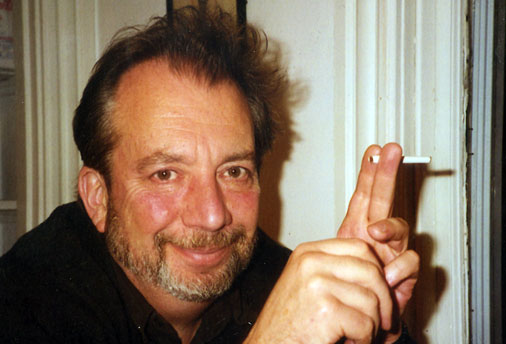
David Hopkins
In 1990 Jeremy Isaacs named a four-hour dramatisation of an early Shelley novel, Zastrozzi (1985) as one of the 10 programmes of which he was most proud during his tenure as Channel 4's chief executive. It was the work of David Hopkins, film-maker, writer, cinema programmer and dramatist, who has died of cancer aged 64. After Zastrozzi came the international award-winning animated post-nuclear satire Sweet Disaster (1986), which David wrote, produced and directed, and, in 1992, Redundant Warrior his HTV/C4 documentary about photographer Don McCullin.
While running the Arnolfini Cinema in Bristol (1970-1973), David had pioneered the contextualised and themed programming that now extends across the arts as with Nicolas Serota's 2002 Tate Modern launch. David clustered new and old films, both mainstream and avant garde, brought back live music to silent classics, and provided some of the first screenings outside London of African and South American radical cinema.
After the Arnolfini he founded, in 1973, Independent Cinema West (ICW). ICW demonstrated David's abiding interest in new technologies for independent film. He planned for production and distribution to be integrated under film makers' control, for Super 8mm (the home movie medium) and video technology to be incorporated with 16mm and 35mm formats for low-cost production; and to bypass conventional distribution with mobile cinemas and mail-order marketing. He used the then infant desktop computer publishing to promote the British independent sector. But his resistance to ICW being overseen from London meant that it received scant public funding.
In 1975, in Bristol he initiated and ran the first Festival of Independent British Cinema. This took in indie features, shorts, political, experimental, "expanded cinema" and multiscreen work on everything from 35mm to Super 8mm and provided film-makers like Derek Jarman with their first significant forum.
David, with his then wife Jane a close partner in his endeavours, then initiated the Independent Cinema Magazine. Its documentation of independent film unearthed by the Festival contributed to C4's subsequent support for independent film-making on its launch in 1982. It was after meeting David at ICW that Isaacs commissioned Zastrozzi.
David was the only son of a sculptor and of a painter. His first novel African Comedy, (1988), drew on his upbringing in the Sudan and at an English boarding school. After studying zoology and drama at Bristol University, he worked at BBC Bristol as a documentary director under John Boorman before becoming a documentaries and educational film-maker in West Africa. Then came the Arnolfini and eventually his work with C4.
But David's star waned with regime changes at the channel and what was becoming a market-driven independent film-making climate. So he turned to novel writing and theatre. So impressed was he by dramatist Charlotte Meehan's talent that he directed her work in Bristol and New York.
It was in New York that he found a home for his energies and in 1999 he settled there with Charlotte, whom he later married, to continue their collaborations to produce off-Broadway theatre and to lecture on film and television at New York University. He later taught his own courses on film acting and digital video film making at Wheaton College, Norton, Massachusetts.
Trenchant, irreverent - fellow leftists were as much a target of his chuckling insights as any - he possessed an exuberant, anarchic imagination. And he had a farsighted vision of film making which inspired many of us to venture beyond our horizons.
He is survived by Charlotte, and their three-year-old daughter, Margot; his first wife Jane and their two children Dan and Kate.
John Furse
David Graydon Hopkins, cinema programmer, film maker, dramatist and writer, born February 7 1940; died May 19 2004.
---------------------------------------------------------
Guardian Newspapers Limited
A member of Guardian Media Group PLC
Registered Office
164 Deansgate, Manchester M3 MGG
Registered in England Number 908396
---------------------------------------------------------
‘THE GUARDIAN’ (UNEDITED) TRIBUTE TO MIKE GRIGSBY BY JOHN FURSE (March 2013)
I was fortunate to work with Mike Grigsby as his researcher on ‘A Life Apart’ (1973) and as his creative collaborator on ‘Living On The Edge’ (1987) and ‘The Time Of Our Lives’ (1994). Mike was a truly cinematic filmmaker whose use of sound, image, pacing and tone made his work stand out for its singularity of vision and purpose and for its essentially poetic nature. To be in his ambit was inspirational, as so many of his collaborators and students found.
That he arrived fully formed at 23 as such a unique filmmaker with his early work ‘Enginemen’ (1959) and that he retained that consistency of vision over more than 50 years was remarkable. It’s no wonder that in its edition on Mike’s retrospective at the Dinard Festival in 2006 Cahiers Du Cinema expressed astonishment at the lack of public recognition for a British filmmaker they name- checked with Karel Reisz, Lindsay Anderson and John Schlesinger.
At the time Mike asked me to collaborate with him on ‘Living On The Edge’ he was keen to extend his creative range. I was the privileged foil for this and found myself once again among the many whom both in his work and in his private life he vitalised with his captivating energy, humanity, good humour and sheer decency.
In his book The Art Of Record (1996) John Corner called ‘Living On The Edge’ “One of the most original documentaries to be shown on British national television during the 1980’s”. Others have called it a ‘masterpiece’ and a ‘pinnacle’ in Mike’s canon. With the support of the British Film Institute it was premiered as a 35mm feature documentary at the ICA, pioneering the cinema distribution of TV documentaries in the UK.
Mike recently called me to express his frustration at the difficulties which the BFI have been facing trying to obtain the rights to make the film available on DVD, as they have long wished, not least because of its great resonance for our times. Let us hope that they eventually succeed as there are few British filmmakers more deserving of posterity’s accessibility to their films. Right now the glass feels all too empty with his departure. But what a glass full he has left us in his life and in his work.